
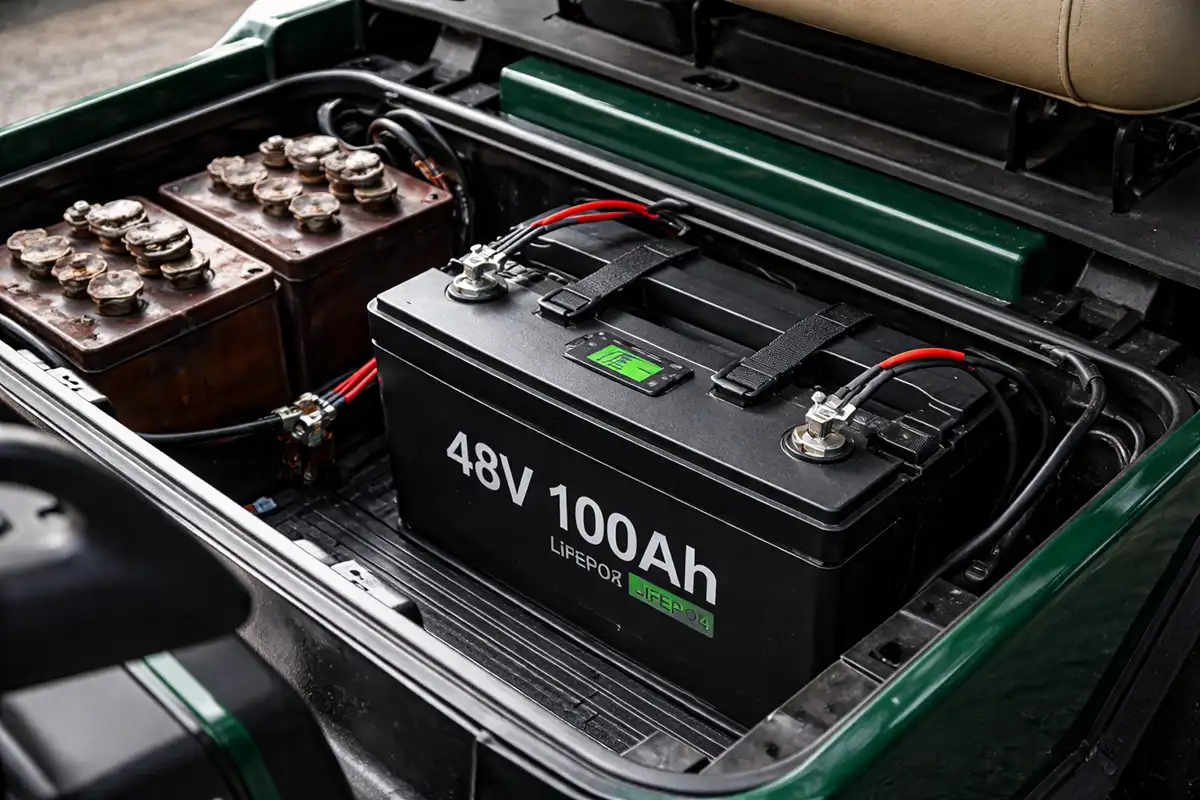
Many older 48V golf carts still rely on multiple lead-acid batteries wired in series. While this setup has worked for decades, lithium iron phosphate (LiFePO4) batteries are becoming a popular alternative due to their longer lifespan, lower maintenance, and improved performance.
One common question that comes up is whether a single 48V 100Ah LiFePO4 battery can realistically replace a traditional multi-battery lead-acid setup. The answer depends on understanding how battery capacity actually works and how the cart is used day to day.
Understanding a Typical 48V Lead-Acid Setup
A common configuration for 48V golf carts uses:
- Six 8-volt lead-acid batteries
- Approximately 170 amp-hours (Ah)
- Wired in series to reach 48 volts
When batteries are connected in series, voltage increases but amp-hours remain the same. While the system may be rated at 170Ah, lead-acid batteries should generally only be discharged to about 50% to avoid excessive wear and premature failure.
That means the usable capacity is closer to 85Ah, not the full rated amount.
How LiFePO4 Capacity Is Different
LiFePO4 batteries are rated very differently from lead-acid batteries. A 48V 100Ah lithium battery can typically be discharged 80–100% without damage, depending on the manufacturer and built-in battery management system (BMS).
In practical terms, this means:
- Usable capacity is often 90–100Ah
- Voltage remains stable throughout the discharge cycle
- Power delivery is consistent until the battery is nearly empty
This is why a lithium battery with a lower Ah rating on paper can still match—or outperform—a higher-rated lead-acid system.
Is One 48V 100Ah LiFePO4 Battery Enough?
For many golf cart owners, the answer is yes.
A single 48V 100Ah LiFePO4 battery is generally sufficient for:
- Daily driving
- Short to moderate distances
- Regular overnight charging
Most golf carts consume energy more efficiently than people expect, especially when used for neighborhood driving, commuting around property, or light recreational use.
Typical Driving and Charging Scenarios
For carts driven:
- Around 3–5 miles per day
- 20–40 minutes at a time
- With access to daily charging
A single lithium battery is usually more than adequate. Lithium batteries also handle frequent partial charges well, unlike lead-acid batteries that prefer deeper charge cycles.
When Would Two Lithium Batteries Be Necessary?
Adding a second 48V lithium battery wired in parallel increases total capacity, but it’s only necessary in certain situations, such as:
- Long daily distances
- Multiple days between charges
- Heavy loads or steep terrain
- High-draw accessories (lights, sound systems, utility equipment)
For standard use, additional capacity often goes unused.
Performance Benefits of Lithium Batteries
Beyond capacity, lithium batteries offer noticeable performance improvements:
- Faster acceleration
- No voltage sag on hills
- More consistent speed
- Reduced stress on electrical components
Many users report that switching to lithium makes an older golf cart feel significantly more responsive.
Weight Reduction and Efficiency
Traditional lead-acid battery banks can weigh several hundred pounds. A single LiFePO4 battery typically weighs far less, resulting in:
- Improved efficiency
- Less strain on suspension and brakes
- Slightly increased range
- Easier maintenance and handling
Weight reduction alone is a compelling reason many owners consider lithium.
Charging Compatibility and Installation
One important consideration is charging. Not all chargers designed for lead-acid batteries are compatible with lithium batteries. Voltage requirements and charging profiles differ.
Before upgrading, it’s wise to:
- Confirm charger compatibility
- Verify battery BMS specifications
- Ensure proper wiring and mounting
In many cases, professional golf cart battery installation can help prevent costly mistakes and ensure the system operates safely and efficiently.
Cost and Long-Term Value
While lithium batteries typically cost more upfront, they often last two to three times longer than lead-acid batteries. They also eliminate:
- Watering
- Terminal corrosion
- Frequent battery replacements
Over time, lithium batteries can be the more economical option.
Lead Acid vs LiFePO4 FAQ
Yes. Because lithium batteries allow deeper discharge, usable capacity is often similar or greater.
In most cases, yes, as long as voltage is correct and components are compatible.
No, provided the battery includes a proper BMS and is correctly installed.
LiFePO4 is one of the safest lithium chemistries available and is widely used in electric vehicles.
Not always, but professional golf cart battery installation can help ensure charger compatibility and system safety.
Yes, lithium-powered golf carts are increasingly desirable on the used market.
Conclusion
For most everyday driving scenarios, a single 48V 100Ah LiFePO4 battery is a practical and effective replacement for a traditional multi-battery lead-acid setup. With better usable capacity, lower weight, and longer lifespan, lithium batteries offer a compelling upgrade path for many 48V golf carts.
231 Beckett Pl #A/B Grover Beach, CA 93433
805-225-5228
[email protected]