Golf carts are no longer limited to quiet golf courses. Today, they’re used in neighborhoods, campgrounds, ranches, resorts, and job sites. As carts become faster, heavier, and more modified with lift kits and larger tires, steering stability becomes a serious concern.
One simple upgrade that many owners consider is a golf cart stabilizer. This small component can dramatically improve steering control, reduce wobble, and increase safety—especially on rough terrain.
In this guide, we’ll explain how to find the right golf cart stabilizer, how to determine if it fits your cart, which brands it typically works with, when you actually need one, and when other fixes may be better.
Why Golf Cart Steering Can Become Unstable
Before installing a stabilizer, it’s important to understand why steering issues happen.
Golf carts often develop steering wobble due to:
- Lift kits raising the center of gravity
- Larger off-road tires
- Worn steering components
- Improper front-end alignment
- High speeds (20+ mph)
- Rough terrain use
When these factors combine, the steering wheel can become loose, twitchy, or unstable at speed.
A stabilizer helps reduce sudden movement in the steering linkage, making the cart feel more planted and predictable.
What a Golf Cart Stabilizer Actually Does
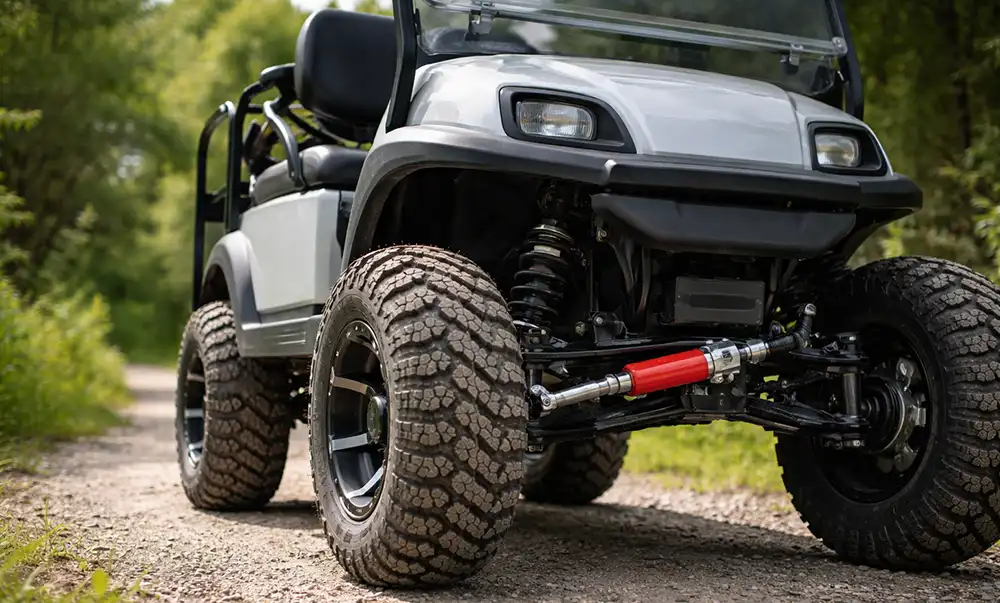
A steering stabilizer is essentially a small shock absorber that attaches between the frame and steering linkage.
Its job is to:
- Absorb sudden steering movements
- Reduce wheel shimmy and wobble
- Improve control on uneven terrain
- Reduce driver fatigue
- Prevent overcorrection when hitting bumps
This technology is widely used in off-road trucks and Jeeps, and the same principle works on golf carts.
Think of it as a shock absorber specifically for your steering system.
How to Find the Right Golf Cart Stabilizer
Not all stabilizers fit every cart, but the good news is many kits are fairly universal.
When searching for a stabilizer, look for products that specify compatibility with:
- Lifted carts
- Larger tires
- Aftermarket suspension kits
Many kits attach using bolt-on brackets, making installation straightforward.
Key Features to Look For
| Feature | Why It Matters |
|---|---|
| Heavy-duty stabilizer shock | Handles larger tires and rough terrain |
| Adjustable brackets | Helps fit different frame designs |
| Bolt-on installation | Easier installation without fabrication |
| Corrosion-resistant finish | Important for outdoor use |
Universal stabilizers are often marketed for off-road vehicles but adapted for carts, especially when used with lift kits.
How to Check if a Stabilizer Will Fit Your Golf Cart
Before purchasing a stabilizer, confirm a few things about your cart.
1. Check Your Suspension Setup
Look at whether your cart has:
- A factory suspension
- An aftermarket lift kit
- Independent front suspension (IFS)
Most stabilizers mount easiest on carts with aftermarket lift kits.
2. Measure Mounting Locations
You’ll need two mounting points:
- One on the cart frame
- One on the steering tie rod or steering rack
If there’s room for the stabilizer to move through its full range of motion, the kit will likely work.
3. Confirm Steering Layout
Some newer carts use rack-and-pinion steering, which may require a different mounting bracket.
Always check the stabilizer’s stroke length and mounting style.
Popular Golf Cart Brands That Stabilizers Often Work With
Many aftermarket stabilizers work across multiple golf cart brands. Fitment usually depends more on the suspension design than the brand itself.
Common compatible brands include:
These carts frequently come with larger tires and lifted suspension, which makes stabilizers particularly useful.
However, even within the same brand, mounting brackets may vary by model year, so always confirm compatibility before purchasing.
Signs Your Golf Cart May Need a Stabilizer
A stabilizer can be a great upgrade if your cart shows these symptoms.
Common Warning Signs
- Steering wheel shakes at higher speeds
- Cart feels unstable on rough terrain
- Tires wobble after hitting bumps
- Steering requires constant correction
- Lift kit installed with large tires
If your cart regularly travels 20 mph or faster, a stabilizer can significantly improve the driving experience.
When You Don’t Need a Stabilizer
A stabilizer should not be used to hide bigger mechanical problems.
If your cart has serious steering issues, the real cause may be:
- Worn bushings
- Loose tie rods
- Bent suspension components
- Bad wheel bearings
- Poor alignment
Fixing these problems first is critical.
Adding a stabilizer to a damaged steering system is like putting a bandage on a bigger issue.
Alternative Fixes for Steering Wobble
Before installing a stabilizer, check these common fixes.
Often they solve the problem completely.
1. Adjust Front Toe Alignment
Front toe alignment is one of the most common causes of wobble.
Most golf carts should have slight toe-in.
Typical recommendation:
1/8″ to 1/4″ toe-in
This means the front of the tires point slightly toward each other.
Improper toe alignment causes:
- Uneven tire wear
- Steering shake
- Wandering at speed
Adjusting toe is usually a simple and inexpensive fix.
2. Tighten Steering Components
Loose steering parts can create play in the system.
Check these components:
- Tie rod ends
- Steering rack bolts
- Steering column mounts
- Control arm bushings
Tightening or replacing worn components often eliminates steering wobble.
3. Inspect Tire Condition
Uneven tire wear can cause vibration and instability.
Look for:
- Cupping
- Uneven tread wear
- Low tire pressure
Replacing damaged tires can make a big difference.
4. Upgrade Steering Components
If your cart runs large off-road tires, you may benefit from:
- Heavy-duty tie rods
- Upgraded bushings
- Stronger steering racks
These upgrades can improve durability and handling.
Benefits of Installing a Golf Cart Stabilizer
When installed correctly, stabilizers offer several advantages.
Improved Safety
They help prevent sudden steering movements when hitting rocks, potholes, or uneven terrain.
Better Control at Higher Speeds
Many modern carts reach 25 mph or more, and stabilizers make these speeds feel more manageable.
Reduced Driver Fatigue
Less steering correction means a more comfortable ride.
Smoother Off-Road Handling
Stabilizers absorb harsh impacts before they reach the steering wheel.
FAQs About Golf Cart Stabilizers
No. Many stock carts work perfectly without one. Stabilizers are most useful on lifted carts, carts with large tires, or carts driven on rough terrain.
Sometimes, but not always. If wobble is caused by poor alignment or worn parts, those issues should be fixed first.
Most kits install in 30–60 minutes using basic tools. Some setups may require custom brackets depending on the cart.
Yes, but the mounting points may differ. Some models require specialized brackets.
In many cases, yes. It reduces sudden steering reactions and helps maintain control on uneven terrain.
For carts with lift kits or oversized tires, stabilizers are usually a low-cost upgrade with noticeable improvements in steering stability.
Final Thoughts
A golf cart stabilizer can be a simple and affordable way to improve steering control and safety—especially on lifted carts or those running larger tires.
However, it’s important to remember that stabilizers work best when the steering system is already in good condition. Always check alignment, steering components, and tire wear before installing one.
For many golf cart owners, the combination of proper alignment, tight steering components, and a stabilizer results in a smoother, safer ride.
Whether your cart is used for work, recreation, or neighborhood cruising, improving steering stability is one upgrade that’s well worth considering.
California Golf Cart Service Center
231 Beckett Pl #A/B Grover Beach, CA 93433
805-225-5228
[email protected]