Article Summary
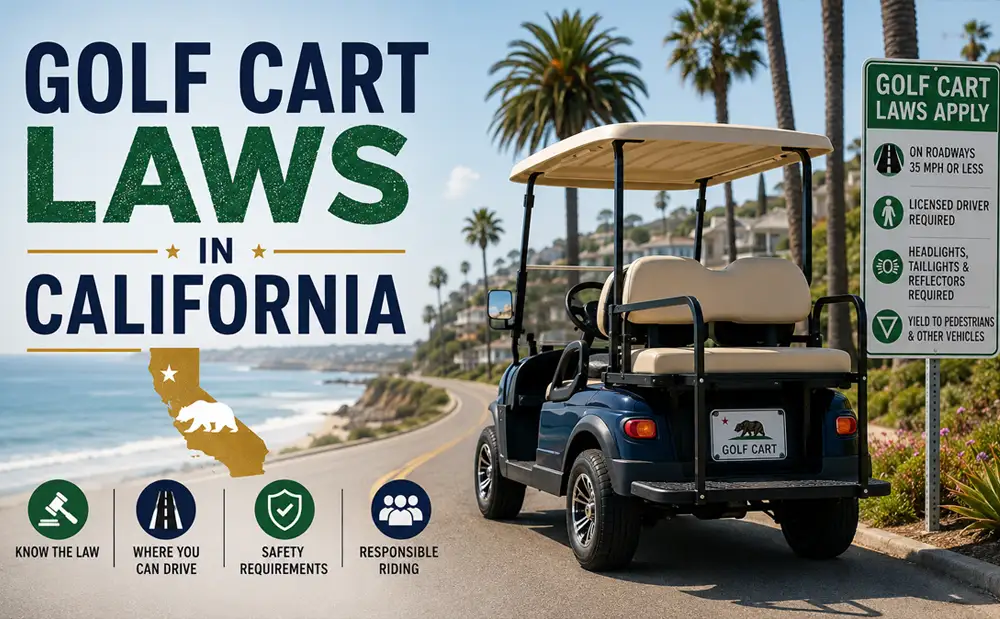
California draws a hard legal line between a standard golf cart and a Low-Speed Vehicle, and understanding which side of that line your cart sits on determines everything about where you can legally drive. Under California Vehicle Code Section 345, a true golf cart is a vehicle with a top speed of 15 mph or less designed to carry golf equipment and no more than two people. That definition limits standard carts to roads with speed limits of 25 mph or less within one mile of a golf course, or inside HOA communities that have been specifically designated for golf cart use.
To drive on most California public roads, you need a vehicle that qualifies as an LSV under CVC Section 21260. That means a four-wheeled electric vehicle with a top speed between 20 and 25 mph, a manufacturer-assigned 17-digit VIN, full FMVSS 500 safety equipment, California DMV registration, and insurance at the new 30/60/15 minimum that took effect January 1, 2025 under SB 1107. An LSV can operate on any California road with a posted speed limit of 35 mph or less.
One important limitation California places on conversion: a standard golf cart that was not built as an LSV cannot be upgraded with safety equipment and then registered as one. The DMV requires the vehicle to have a manufacturer-assigned VIN and factory FMVSS 500 certification. This means the practical route to a street-legal cart in California is purchasing a factory-built LSV, not modifying an existing cart.
Standard golf cart
25 mph roads, 1 mile of golf course only
LSV road access
Any road up to 35 mph
Minimum age
16 (valid CA license required)
DMV registration
Required for LSVs
Insurance minimum
30/60/15 (SB 1107, Jan 2025)
Conversion allowed
No (factory VIN required)
Golf cart vs LSV in California: why the distinction matters
Most states use the terms loosely. California does not. The Vehicle Code creates two completely separate categories that carry very different road access rights, and knowing which one applies to your vehicle is the first question to answer before you drive anywhere.
| Category | California definition | Where you can drive |
|---|---|---|
| Golf cart (CVC §345) | 15 mph max, under 1,300 lbs, carries golf equipment and up to 2 people | 25 mph roads within 1 mile of a golf course, or designated HOA golf cart community |
| LSV / NEV (CVC §385.5) | 20–25 mph, 4 wheels, FMVSS 500 compliant, manufacturer VIN | Any road with posted speed limit of 35 mph or less, statewide |
NEV and LSV are the same legal classification. NEV (Neighborhood Electric Vehicle) is the term used most often in HOA documents and community rules. LSV is the term used by the California DMV and CHP for registration and enforcement. If someone tells you their community requires an NEV, they are describing the same vehicle the DMV registers as an LSV.
The no-conversion rule: what most buyers get wrong
This is the most common misunderstanding among California golf cart buyers. People see neighbors driving around in what looks like a modified EZGO or Club Car and assume it has been converted and registered. In some cases those vehicles are operating in HOA-designated golf cart zones under the golf cart rules, not as registered LSVs. In other cases they may simply be unregistered and not legal on the road they are using. Do not assume another cart on the street is evidence that yours would be legal in the same location.
How to register an LSV with the California DMV
If you are purchasing a factory-built LSV, the process is straightforward and similar to buying a new car. Here is how it works:
- Obtain a completed Application for Title or Registration (Form REG 343) from the California DMV or at dmv.ca.gov.
- Gather the Manufacturer’s Certificate of Origin from your dealer, which confirms the vehicle was manufactured as an LSV with a proper 17-digit VIN.
- Secure California liability insurance at the new SB 1107 minimum: $30,000 per person, $60,000 per accident, $15,000 property damage. This took effect January 1, 2025.
- Submit the form, certificate of origin, proof of insurance, and applicable fees to a California DMV office.
- Receive your California license plate and registration card. The plate must be displayed on the rear of the vehicle.
Most factory-built LSV dealers handle the paperwork on your behalf during the purchase. The title and registration are processed the same way as any new vehicle sale. You drive it home legal.
Required LSV equipment under FMVSS 500
- DOT-approved headlights and taillights
- Brake lights
- Front and rear turn signals
- Rearview mirror and side mirrors
- Seat belts for all occupants
- Windshield (DOT-approved safety glass)
- Parking brake
- Speedometer
- Horn
- Manufacturer-assigned 17-digit VIN
- California DMV registration and license plate
- Liability insurance at 30/60/15 minimum
The 2025 insurance change: SB 1107
Effective January 1, 2025, California’s minimum auto liability limits increased under Senate Bill 1107. The previous minimums of 15/30/5 were in place for decades and are no longer valid. The new minimums are $30,000 per person, $60,000 per accident, and $15,000 property damage. LSVs are registered as motor vehicles and subject to the same insurance requirement as any other car on California roads. If your policy was written before January 2025, confirm with your insurer that your coverage has been updated to meet the new minimums.
Canyon Lake, Riverside County, and HOA golf cart communities
Canyon Lake is the most prominent example of a California community where golf cart use is deeply woven into daily life. The city is a gated community of roughly 11,000 residents where registered LSVs and neighborhood golf carts are a common form of transportation for local errands and community events. Under California law, residents inside Canyon Lake using the community’s designated golf cart zones may operate under the golf cart provisions. For anyone leaving the gate and driving on public roads outside the community, LSV registration is required.
The same layered approach applies in other Inland Empire communities including Menifee, Lake Elsinore, and Murrieta, and in the Palm Desert area. Your HOA may authorize cart use on private roads within the community, but those rules do not automatically extend to any public road you cross or connect to. Always verify with your HOA and confirm whether the roads you plan to use are public or private before assuming your cart is legal on them.
This page is for general informational purposes only and is not legal advice. California golf cart and LSV laws can change. Always verify current requirements with the California DMV at dmv.ca.gov before operating on public roads. Central Coast Carts is not responsible for errors or omissions. Last reviewed June 2026.
Frequently Asked Questions – California Golf Cart Laws
Are golf carts street legal in California?
Standard golf carts (15 mph or less) are only legal on 25 mph roads within one mile of a golf course, or inside designated HOA golf cart communities under CVC Section 345. For broader road access, a vehicle must be registered as an LSV with the California DMV under CVC Section 21260 and can then operate on any road with a speed limit of 35 mph or less.
What is the difference between an NEV and an LSV in California?
Nothing legally. NEV and LSV refer to the same vehicle classification under CVC Section 385.5. NEV is the term used in HOA documents. LSV is the term the California DMV and CHP use for registration and enforcement. Both refer to a four-wheeled electric vehicle with a top speed between 20 and 25 mph that meets FMVSS 500 federal safety standards.
How do I register a golf cart as an LSV with the California DMV?
Submit Form REG 343 and the Manufacturer’s Certificate of Origin to the California DMV along with proof of 30/60/15 liability insurance. The vehicle must have a factory-assigned 17-digit VIN and meet all FMVSS 500 requirements. Most factory-built LSV dealers handle this paperwork during the sale.
What is the insurance minimum for an LSV in California?
Under SB 1107, effective January 1, 2025, the new minimum is $30,000 per person, $60,000 per accident, and $15,000 property damage (30/60/15). This applies to all registered LSVs in California.
Can I convert my golf cart to an LSV in California?
In most cases, no. The California DMV requires a manufacturer-assigned 17-digit VIN and factory FMVSS 500 certification. A standard cart that was not built as an LSV cannot be retrofitted and then registered as one. Purchase a factory-built LSV to avoid this issue.
Is the Denago Rover XL street legal in California?
Yes. It is a factory-built LSV with a manufacturer VIN and full FMVSS 500 compliance. It registers with the California DMV using Form REG 343 and can be driven on any road with a speed limit of 35 mph or less statewide.