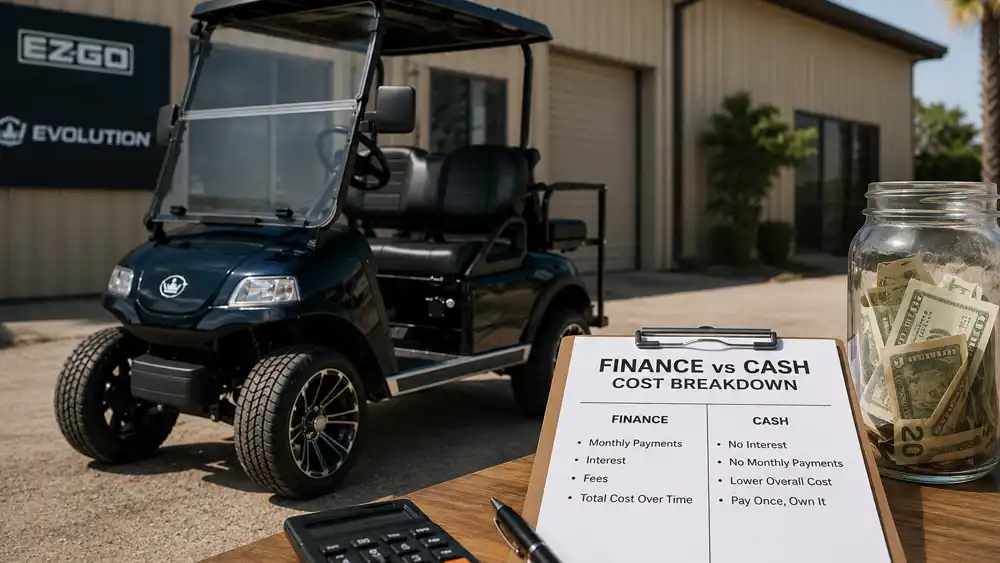
Summary: Whether you should finance a golf cart or pay cash depends on your interest rate, what you would otherwise do with that cash, and how long you plan to keep the cart. Paying cash eliminates interest costs entirely and is the financially optimal choice if your alternative use for that money earns less than your loan rate. Financing makes sense when you want to preserve liquidity, when the monthly payment fits comfortably within your budget, or when promotional rates bring the total interest cost low enough that the cash opportunity cost exceeds it. For most buyers purchasing a street-legal LSV between $8,000 and $15,000, a 36 to 48 month loan with a competitive rate adds $700 to $2,000 in total interest depending on the rate, a meaningful but not prohibitive cost for the convenience of spreading payments over time.
Golf carts do not get the same financial scrutiny that car purchases do, even though the decision involves the same core trade-off: pay more now to pay less overall, or pay less now and carry a financing cost over time. This guide is designed to give you the actual numbers so you can decide what makes sense rather than just going with whatever feels comfortable in the moment.
We will cover how golf cart loans work, what interest rates look like for different credit profiles, how to think about the cash opportunity cost, and when each approach makes the most financial sense. We are not financial advisors, and your specific situation should ultimately guide your decision — but the framework here applies to most golf cart purchases in the $6,000 to $20,000 range.
How Golf Cart Financing Works
Golf cart financing works similarly to financing any recreational vehicle or personal property purchase. A lender provides the funds to cover the purchase price, you take ownership of the cart, and you repay the loan with interest over an agreed term. Terms typically run between 24 and 60 months, and the interest rate is set based on your credit profile, the lender, and current market rates.
Some lenders classify golf carts as recreational vehicles and apply RV loan criteria. Others treat them as personal property or chattel loans. Dealers with in-house financing relationships or manufacturer programs can sometimes offer promotional rates on new inventory that are lower than what you would find applying independently at a bank or credit union.
A key distinction to understand is that golf cart loans are almost always unsecured or secured against the cart itself, not against real property. This means the approval criteria and interest rates are different from a home equity loan even though some buyers consider using home equity to finance a significant purchase. If you have access to a low-rate home equity line of credit, that financing route can be financially advantageous compared to a standard golf cart loan — though it involves pledging your home as collateral, which is a different risk profile entirely.
What Golf Cart Loan Rates Look Like in 2026
Interest rates on consumer loans have remained elevated compared to the 2020 to 2021 era. Buyers with strong credit (typically a FICO score of 700 or above) can generally access golf cart financing in the 7 to 12 percent annual percentage rate range through banks, credit unions, or dealer-arranged lenders. Fair credit (620 to 699) typically pushes rates into the 12 to 18 percent range, and rates above 18 percent are common for borrowers below 620.
The practical impact of those differences is significant over a multi-year loan. At 9 percent APR on a $12,000 purchase over 48 months, total interest paid is approximately $2,300. At 15 percent APR on the same loan, total interest climbs to approximately $4,000. That $1,700 difference is enough to meaningfully change the calculus of whether financing makes sense.
Note: Interest rates change frequently. The figures in this article reflect general market conditions as of mid-2026 and are provided for illustrative purposes. Ask your lender or our team for current rate estimates based on your specific profile.
Monthly Payment and Total Cost Examples
The table below shows estimated monthly payments and total interest paid for a $12,000 golf cart purchase at different rates and loan terms. These figures assume no down payment and are calculated using standard amortization.
| Loan Amount | APR | Term | Monthly Payment | Total Interest |
|---|---|---|---|---|
| $12,000 | 7% | 36 mo. | ~$371 | ~$356 |
| $12,000 | 7% | 48 mo. | ~$287 | ~$776 |
| $12,000 | 9% | 36 mo. | ~$381 | ~$716 |
| $12,000 | 9% | 48 mo. | ~$299 | ~$352 |
| $12,000 | 12% | 36 mo. | ~$398 | ~$1,333 |
| $12,000 | 12% | 48 mo. | ~$316 | ~$1,764 |
| $12,000 | 15% | 48 mo. | ~$333 | ~$3,986 |
A smaller down payment reduces the financed amount and therefore reduces both the monthly payment and total interest paid. Putting $2,000 down on a $12,000 cart and financing the remaining $10,000 at 9 percent over 48 months brings total interest down to approximately $1,960 and the monthly payment to approximately $249.
The Case for Paying Cash
Paying cash for a golf cart eliminates interest entirely, which is the simplest argument for doing it. There is no monthly obligation, no lender relationship to manage, and no risk of the cart being worth less than the remaining loan balance if something changes in your circumstances. For buyers who have the cash available and no competing high-return use for it, the math is straightforward: cash is cheaper.
Cash purchases can also sometimes create negotiating leverage at the point of sale. A buyer who is not dependent on dealer-arranged financing has more flexibility in the transaction, and some dealers are willing to negotiate on price or add-ons when financing commissions are not part of the deal.
The scenario where cash is clearly the right choice is when your alternative use for the money earns less than the loan interest rate. If you have $12,000 sitting in a savings account earning 4 percent and the loan rate is 9 percent, you are effectively paying 5 percent per year to keep that money liquid. Paying cash saves the spread.
The Case for Financing
Financing makes the most sense in a few specific situations. First, if you have access to a genuinely competitive rate (7 percent or below) and the monthly payment fits comfortably within your budget without strain, the total interest cost may be low enough that preserving cash liquidity is worth the carrying cost.
Second, if the cash you would spend on the cart is currently invested in something earning a higher return than the loan rate, you come out ahead mathematically by keeping the money invested and financing the cart. This scenario is less common in a higher-rate environment but is worth running the numbers on.
Third, if purchasing a better-equipped cart on a payment plan enables you to get the cart you actually want rather than a lesser version you can afford in cash, the quality-of-life difference over years of ownership may justify the financing cost. This is particularly relevant when comparing a lithium-equipped model against a lead acid model at a lower cash price. The avoided battery replacement cost on the lithium cart can offset meaningful financing interest over a four to five year holding period.
If you are exploring how battery type affects long-term ownership costs, our guide on 48V golf cart batteries: lead acid vs LiFePO4 walks through the real cost difference between the two systems over time.
Financing a Street Legal Golf Cart: What Changes
If the golf cart you are buying will be registered as a street legal low speed vehicle in California, there are a few additional cost considerations that affect the financing versus cash comparison.
First, LSV-registered carts require insurance if driven on public roads in California. That insurance cost is ongoing and does not change based on whether you financed or paid cash. However, if you financed the cart, your lender may require comprehensive and collision coverage as a condition of the loan, which is a higher premium requirement than liability-only coverage.
Second, street legal carts have higher purchase prices than recreational-only carts in the same brand lineup, because the LSV-compliant equipment is more expensive to manufacture and install. That higher base price increases the financed amount, which makes the rate and term decision more consequential. A $15,000 street-legal cart at 12 percent over 48 months carries roughly $2,200 more in total interest than the same cart at 7 percent. That spread is wide enough to make rate shopping genuinely worth the effort.
You can also read more about golf cart insurance in California and golf cart titles in California to understand the full cost picture before you finalize your purchase decision.
Five Questions to Ask Before You Decide
1. What rate can you actually get?
Get a real pre-qualification from at least one lender before you are sitting at a desk making a purchase decision. The rate matters more than almost any other factor in this analysis.
2. What is your cash doing right now?
If the cash is sitting in a low-yield account earning under 5 percent, paying cash is almost certainly the better financial decision at current loan rates. If the cash is invested and generating consistent returns above your available loan rate, financing may be the better move.
3. How long do you plan to keep the cart?
The longer you keep the cart, the more a lithium battery premium pays off and the less the interest cost matters relative to total ownership value. If you think you will sell or trade within two years, minimizing cash outlay and preserving resale flexibility matters more. If you intend to own for five or more years, paying for quality upfront or financing to reach a better-equipped model makes more sense.
4. Will the monthly payment create financial stress?
A golf cart is not a necessity for most buyers. If the monthly payment would create financial strain in a month where the car needs work or an unexpected expense arises, that strain erodes the quality-of-life benefit the cart was supposed to provide. If you are on the fence, a shorter term or larger down payment reduces this risk.
5. Does the cart you want require financing to access?
If the cart you genuinely want sits above your cash budget, the financing decision is partly about whether the gap is worth a payment plan. Upgrading to a lithium-equipped cart via financing to avoid a near-term lead acid replacement cost is a legitimate reason to carry a loan. Financing a cart because it has a more attractive color is not.
Resale Value and Being Upside Down on a Loan
One risk specific to financing that cash buyers never face is being upside down on the loan — meaning you owe more than the cart is worth. Golf carts depreciate, though at varying rates depending on brand, battery type, and whether the cart is street-legal registered. If you finance 100 percent of a $13,000 cart and then need to sell it 18 months later, you may find that the cart’s resale value has dropped to $9,000 while you still owe $10,500.
The best way to protect against this is a meaningful down payment (15 to 20 percent of purchase price), choosing a cart with strong resale fundamentals (lithium battery, LSV registration, recognized brand), and avoiding loan terms that significantly outlast your intended ownership period. You can read more about what factors affect what a used golf cart is worth in the California market.
Central Coast Carts offers financing options on new and pre-owned golf carts at our Grover Beach location. If you want to explore what your payment would look like on a specific cart, call us at (805) 225-5228 or stop by 231 Beckett Pl and we will walk through the numbers with you honestly.
Frequently Asked Questions
What are typical golf cart loan interest rates?
Buyers with good credit (700 and above) typically see rates in the 7 to 12 percent APR range. Fair credit borrowers may see 12 to 18 percent or higher. Some dealers offer promotional rates through manufacturer programs on new inventory. Rates as of mid-2026 are higher than the 2020 to 2021 era, so shopping multiple lenders before committing is worth the time.
Can you get a golf cart loan with bad credit?
Financing is possible with lower credit scores, but the rate will be meaningfully higher. A larger down payment can offset a higher rate by reducing the financed principal. If your score is below 620, reviewing your credit report for errors and asking about secured loan options is worth doing before committing to a high-rate unsecured loan.
Is it better to finance a new golf cart or a used one?
New golf carts are generally easier to finance at competitive rates because lenders can more clearly establish collateral value. Used carts can be financed but may require a lower loan-to-value ratio, meaning a larger down payment. When comparing a new lithium model on a 48-month loan against a cheaper used cart paid in cash, the math often favors the new cart when avoided battery replacement costs are factored in.
Does financing a golf cart affect your credit score?
Yes, in both directions. Applying for financing triggers a hard inquiry that temporarily drops your score by a few points. Making consistent on-time payments builds positive payment history and can improve your score over time. Late or missed payments have the same negative impact as any other installment loan.
What is the typical loan term for a golf cart?
Golf cart loan terms typically run 24 to 60 months. Shorter terms mean higher monthly payments but significantly less total interest. For a $10,000 cart at 9 percent APR, the difference between a 36-month and 60-month loan is roughly $600 to $900 in total interest paid over the life of the loan.