
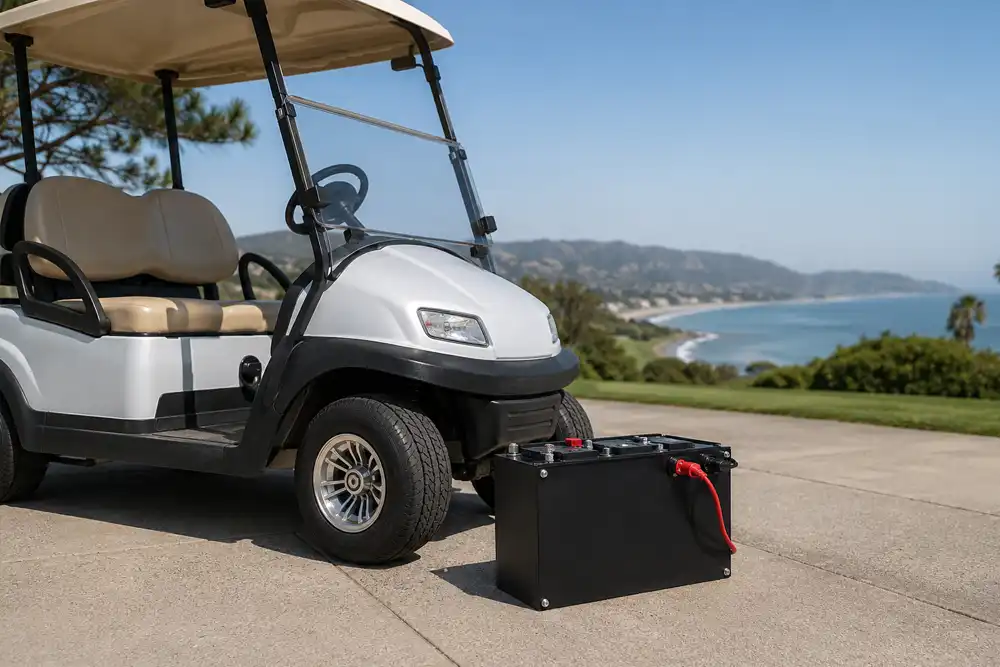
Quick Answer: Converting a golf cart from lead acid to LiFePO4 lithium batteries typically costs $1,800 to $3,500 professionally installed and delivers 30 to 50 percent more usable range, dramatically faster charging, and a battery that lasts 8 to 10 years instead of 3 to 5. The conversion makes sense when the rest of the cart is in good condition. If the motor, controller, or body have multiple issues, the combined cost of conversion plus other repairs may justify buying a new lithium-equipped cart instead.
If your golf cart’s batteries are at the end of their life, you have two choices. You can replace the lead acid pack with new lead acid batteries and reset the clock by three to five years. Or you can convert to lithium and change the economics of ownership for the next decade. This guide walks through the real numbers so you can make an informed choice.
We install lithium conversions at our service department in Grover Beach, so the costs and outcomes described here reflect actual work we have done, not estimates from a manufacturer’s marketing sheet.
Why Lead Acid Batteries Wear Out Faster Than You Expect
A standard 48-volt lead acid battery bank in a golf cart typically delivers 300 to 500 charge cycles before meaningful performance degradation. For a cart that is charged three to four times per week, that translates to roughly three to four years before the battery pack starts delivering noticeably less range.
Lead acid batteries also lose capacity faster when they are regularly discharged below 50 percent of their rated capacity. Many recreational golf cart users run their carts until the cart slows noticeably before recharging, which is well below the 50 percent mark. That usage pattern accelerates degradation significantly compared to the manufacturer’s cycle life estimate, which is calculated under controlled discharge conditions.
By the time a lead acid pack reaches the end of its useful life, it has typically also gained water consumption problems, sulfation on the plates, and capacity reduction that makes the cart feel sluggish even after a full charge. Replacing the pack with new lead acid restores performance temporarily but resets you to the same three to five year replacement cycle.
What Lithium Actually Changes
A LiFePO4 lithium pack in the same 48-volt configuration delivers a different ownership experience in several meaningful ways.
Range and Consistency
Lithium batteries maintain consistent voltage output throughout the discharge cycle. Lead acid batteries experience voltage sag as they discharge, which causes the cart to slow and feel sluggish before the battery is technically empty. With lithium, the cart performs at full strength until the battery management system signals a low state of charge. Most owners report a 30 to 50 percent increase in usable range after conversion, even with a pack rated at the same nominal capacity.
Charge Time
Lead acid packs require 8 to 12 hours for a full charge. A lithium pack in the same application typically charges fully in 4 to 6 hours. For owners who use their cart daily, that difference means morning charging is often sufficient rather than overnight, and a cart that was run down during an outing can be meaningfully recharged in a few hours.
Weight Reduction
A standard 48-volt lead acid bank weighs approximately 200 to 250 pounds depending on the individual batteries used. A comparable LiFePO4 lithium pack weighs 60 to 80 pounds. Removing 140 to 170 pounds of dead weight from the cart improves acceleration, range, and braking. On hilly terrain, this weight reduction is particularly noticeable.
Maintenance Requirements
Lead acid batteries require monthly water level checks and periodic equalization charges. Failure to maintain proper water levels accelerates plate damage and shortens battery life. Lithium packs require none of this attention. They do not need watering, equalization, or any routine maintenance beyond keeping the terminals clean and the battery management system functioning.
Lead Acid vs LiFePO4: A Realistic Comparison
| Category | Lead Acid (48V) | LiFePO4 Lithium (48V) |
|---|---|---|
| Typical Cost (replacement) | $800–$1,400 | $1,800–$3,500 installed |
| Cycle Life | 300–500 cycles | 2,000–3,000 cycles |
| Estimated Lifespan | 3–5 years | 8–12 years |
| Charge Time | 8–12 hours | 4–6 hours |
| Weight | 200–250 lbs | 60–80 lbs |
| Maintenance | Monthly watering | None required |
| Voltage Sag | Yes, significant | Minimal |
| 10-Year Battery Cost | $2,400–$4,200 | $1,800–$3,500 |
The 10-year battery cost comparison is the most important column for buyers trying to justify the higher upfront cost. Lead acid typically requires two to three replacement cycles over ten years, which brings the total cost of lead acid ownership well above the one-time cost of a quality lithium pack. You can read a more detailed breakdown of the chemistry and cost differences in our guide on 48V golf cart batteries: lead acid vs LiFePO4.
What a Lithium Conversion Actually Involves
A proper lithium conversion is not simply swapping out the old batteries for new ones. It involves removing the existing lead acid bank, installing a new LiFePO4 pack with an integrated battery management system (BMS), and in most cases replacing or reprogramming the onboard charger to use a lithium-compatible charging profile.
The battery management system is the critical component. A BMS monitors cell voltages, temperature, and state of charge across all cells in the pack. It prevents overcharging, prevents deep discharge damage, and balances cell voltages to extend pack longevity. A lithium pack without a BMS is not a safe or sensible installation.
Charger compatibility is also not guaranteed. Many older golf cart chargers use a charging algorithm designed for lead acid chemistry, which delivers a higher finishing voltage than lithium packs can safely accept. Some chargers can be reprogrammed. Others need to be replaced. This charger compatibility check is a step that some budget conversion kits skip, which can shorten lithium pack life or trigger safety shutoffs.
What to avoid: Very low-cost lithium conversion kits sold online often use cheaper cell chemistry, no BMS, or minimal BMS protection. The upfront savings are real, but the failure rates and safety risks are higher. For a cart you depend on, professional installation with a quality LiFePO4 pack and verified BMS is the right approach.
Does Lithium Conversion Help Resale Value?
Yes, meaningfully. A cart with a documented lithium upgrade commands $1,500 to $2,500 more in the California resale market than the same cart with a comparable lead acid pack, because buyers understand they are buying years of battery life rather than a system that may need replacement soon. This premium is well-established in our local market and holds across brands.
Documentation matters. Keep the installation receipt, battery model and specifications, and BMS information. A buyer who can verify what lithium chemistry was used and when it was installed will pay more than a buyer who just has to take the seller’s word for it. You can read more about what drives resale value for California cart owners in our guide on what your golf cart is worth.
When to Convert vs When to Buy New
The conversion makes clear financial sense when the rest of the cart is in solid condition and the battery is the primary problem. If the motor runs well, the controller has no issues, the body and frame are sound, and the cart is otherwise functional, a lithium conversion extends the useful life of that cart by a decade at a fraction of the cost of buying new.
The calculation changes when the cart has multiple problems beyond the battery. If the motor is showing wear, the controller has recurring faults, the body has significant damage, or the cart requires several thousand dollars in additional repairs alongside the battery conversion, the combined cost may approach or exceed the price of an entry-level new cart with a factory lithium pack and full warranty.
A rough decision framework: if the total cost of the lithium conversion plus any other needed repairs would exceed $5,000, it is worth pricing new options before committing. Entry-level new street-legal carts with factory lithium start under $10,000. The three to four thousand dollar gap may be worth it for a full warranty, new body and frame, and a guaranteed fresh battery system from day one.
If you are not sure which direction makes more sense for your specific cart, bring it to our service department in Grover Beach. We can assess the cart’s overall condition and give you an honest recommendation on whether conversion or replacement is the better value.
What the Conversion Process Looks Like at Our Shop
When you bring a cart to us for a lithium conversion, we start with a full assessment of the motor, controller, wiring, and charger before we order any parts. We want to confirm that the rest of the cart is worth investing in before we proceed. If we find other issues that change the value calculation, we tell you before any work begins.
The conversion itself typically takes one to two days. We remove the lead acid bank, clean and inspect the battery compartment, install the LiFePO4 pack with the BMS, verify charger compatibility, and test the system under load before the cart leaves our shop. We provide full documentation of the battery specifications and installation date for your records.
Our lead acid to lithium battery conversion service page has more detail on what the process includes and how to get a quote for your specific cart.
Thinking about a lithium conversion or not sure if your cart is worth investing in? Bring it by our Grover Beach location at 231 Beckett Pl or call us at (805) 225-5228. We will take a look and give you a straight answer on whether conversion or replacement makes more sense.
Frequently Asked Questions
How much does it cost to convert a golf cart to lithium batteries?
A quality LiFePO4 lithium conversion professionally installed typically costs $1,800 to $3,500 for a 48-volt golf cart. The range reflects differences in battery pack capacity, cell quality, and whether the existing charger needs to be replaced or reprogrammed. Budget-tier kits are available for less but often use lower-grade cells that do not deliver the safety and longevity of quality LiFePO4 chemistry.
What is the difference between LiFePO4 and other lithium batteries for golf carts?
LiFePO4 is the safest and most durable lithium chemistry for golf cart use. It is thermally stable, does not overheat under normal conditions, and delivers 2,000 to 3,000 charge cycles before meaningful degradation. Other lithium chemistries offer higher energy density but carry greater thermal risk and shorter cycle life. For golf carts, LiFePO4 is the recommended choice.
Does a lithium conversion improve golf cart range?
Yes, significantly. Lithium packs deliver consistent voltage throughout the discharge cycle, eliminating the voltage sag that causes lead acid carts to slow before the battery is fully depleted. Most owners see a 30 to 50 percent increase in usable range after conversion.
Does lithium battery conversion increase golf cart resale value?
Yes. A documented lithium upgrade adds $1,500 to $2,500 in resale value in the California market. Documentation of the installation and battery specifications is important for capturing this premium when selling.
When is it better to buy a new cart instead of converting?
When the total cost of the lithium conversion plus other needed repairs exceeds $5,000, it is worth comparing that investment against the cost of a new entry-level cart with a factory lithium pack and full warranty. If the rest of the cart is in solid condition, conversion is almost always the better value. If multiple systems need attention, new may be the smarter path.