Summary: Golf cart mud tires use deep, wide-spaced tread to grip soft dirt, mud, and loose ground. They shine on trails, farms, and wet dirt. On pavement, they are louder and wear faster. Taller tires usually need a lift kit. They can also raise your top speed and affect street-legal status. This guide explains when mud tires make sense, how to pick a size, and what else to plan for.
Standard golf cart tires are built for turf and pavement. They are smooth and quiet. But they slip fast in mud, wet grass, and loose dirt.
If your cart leaves the pavement, mud tires may be worth a look. Still, they are not a simple swap. So let’s cover what they do, what they cost you, and how to choose well.
What Are Golf Cart Mud Tires?
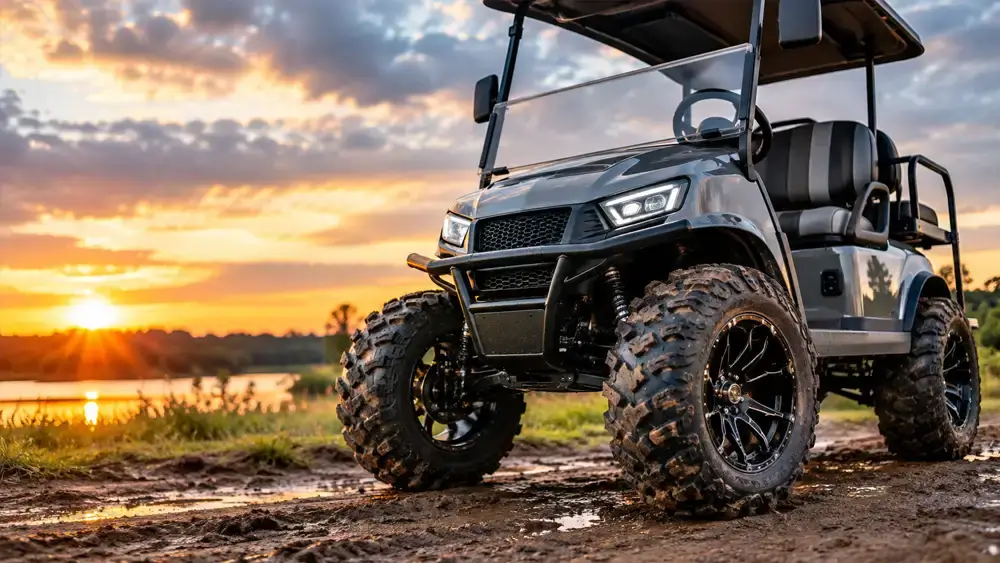
Mud tires have deep tread blocks with wide gaps between them. The gaps let mud and dirt clear out as the tire spins. That keeps the tire gripping instead of packing up and sliding.
You will see them on lifted carts, hunting carts, and farm carts. They look rugged. They also work better in soft ground than street tires do.
Mud Tires vs. All-Terrain vs. Street Tires
Not every cart needs a full mud tire. Here is how the three main types compare.
| Tire type | Best on | Weak spot |
|---|---|---|
| Street or turf tire | Pavement, golf courses, paths | Slips in mud and loose dirt |
| All-terrain tire | Mixed use: roads, dirt, light trails | Less grip than mud tires in deep mud |
| Mud tire | Soft dirt, wet fields, muddy trails | Louder, wears faster, rougher on pavement |
If you split time between pavement and dirt, an all-terrain tire may fit better. Mud tires make the most sense when soft ground is your daily reality.
When Mud Tires Are Worth It
Mud tires help in these cases:
- Hunting and trail use. Wet leaves and soft soil are easy to get stuck in.
- Farm and ranch work. Irrigated rows and muddy lanes need extra grip.
- Rainy-season driveways. Gravel and clay get slick fast.
- Camps and large properties. Uneven ground is hard on smooth tires.
If you mostly drive on streets and sidewalks, skip them. You will pay more and get a noisier ride for no benefit.
How to Pick the Right Size
Tire size is written like 22×10-10. That means 22 inches tall, 10 inches wide, and made for a 10-inch wheel. Here is how to choose.
- Know your wheel size. Most carts run 8, 10, 12, or 14-inch wheels. Your tire must match.
- Check your clearance. A taller tire needs room in the wheel wells.
- Plan for a lift. Many larger tires need a lift kit to avoid rubbing. Read our lift kit guide first.
- Match tire and wheel as a set. Our guide to golf cart wheels explains your options.
When in doubt, ask a pro. A wrong size can rub the body, strain the motor, or hurt handling.
What Mud Tires Change on Your Cart
Bigger, heavier tires change how the cart behaves. Know the trade-offs before you buy.
Speed and range
A taller tire covers more ground per turn. So your cart can go faster than before. At the same time, heavy tires add drag. That can shorten your battery range. Our guide on how far an electric golf cart can go helps you plan.
Torque and hill climbing
Taller tires act like a taller gear. The motor works harder to move them. On stock motors, you may notice slower launch and weaker climbing.
Pavement noise and wear
Mud tread hums on pavement. It also wears down faster on hard surfaces. Expect a bumpier ride too.
Street Legal Carts and Mud Tires
This part matters. In California, a street-legal low-speed vehicle (LSV) must stay between 20 and 25 mph. A taller tire can push your real speed higher. That could put you outside LSV limits. Tires on a road-going cart should also be road-appropriate, so confirm before you swap.
Not sure where you stand? Read golf cart laws in California. If you want a cart that stays road ready, see our street legal golf carts for sale.
Buying a Cart Built for Rough Ground
You can upgrade tires later. Or you can start with a cart made for it. Our lifted golf carts page shows models with extra clearance and larger tire setups. The Activ EV Pulse 6 Lifted is one example. You can also browse new golf carts and used golf carts.
Install and Care Tips
- Have a pro mount them. Larger tires are harder to seat. Our tire service can help.
- Check pressure often. Low pressure causes wear and poor grip.
- Rinse after muddy rides. Caked mud adds weight and hides damage.
- Learn the flat fix. See how to fix a flat tire on a golf cart.
- Check your brakes. Heavier tires add stopping load.
Planning bigger changes? Our article on extreme golf cart modifications shows what else owners add. If you drive in the Central Valley, our sister company has a guide to all terrain golf carts.
Frequently Asked Questions
What are golf cart mud tires?
Golf cart mud tires have deep, wide-spaced tread blocks that grip soft dirt, mud, and loose ground. The gaps clear mud as the tire turns, so the tire keeps its grip. They are common on lifted, hunting, and farm carts.
Do golf cart mud tires need a lift kit?
Often, yes. Mud tires are usually taller and wider than stock tires, so they can rub the body or fender wells. A lift kit adds the clearance. The exact need depends on the tire size and your cart model.
Can I use mud tires on a street-legal golf cart?
It depends. Taller tires can raise your top speed, and a street-legal LSV in California must stay between 20 and 25 mph. Road-going carts should also use road-appropriate tires. Check with a dealer before you swap.
What size mud tires fit a golf cart?
Tires are labeled like 22×10-10, meaning 22 inches tall, 10 inches wide, and made for a 10-inch wheel. The right size depends on your wheel diameter, body clearance, and whether you have a lift kit.
Do mud tires slow down a golf cart?
They can reduce range and acceleration because the tires are heavier and act like a taller gear. At the same time, a taller tire covers more ground per turn, which can raise top speed. The net effect depends on the cart and tire size.
Are mud tires or all-terrain tires better for a golf cart?
All-terrain tires suit mixed use, such as pavement plus light dirt. Mud tires suit soft, wet ground. If you drive mostly on pavement, all-terrain or standard tires are the better pick.
Need Tires Installed or a Cart That Can Handle Dirt?
Call Central Coast Carts at 805-225-5228 or visit our Grover Beach showroom. We can help with sizing, installation, and lifted cart options.