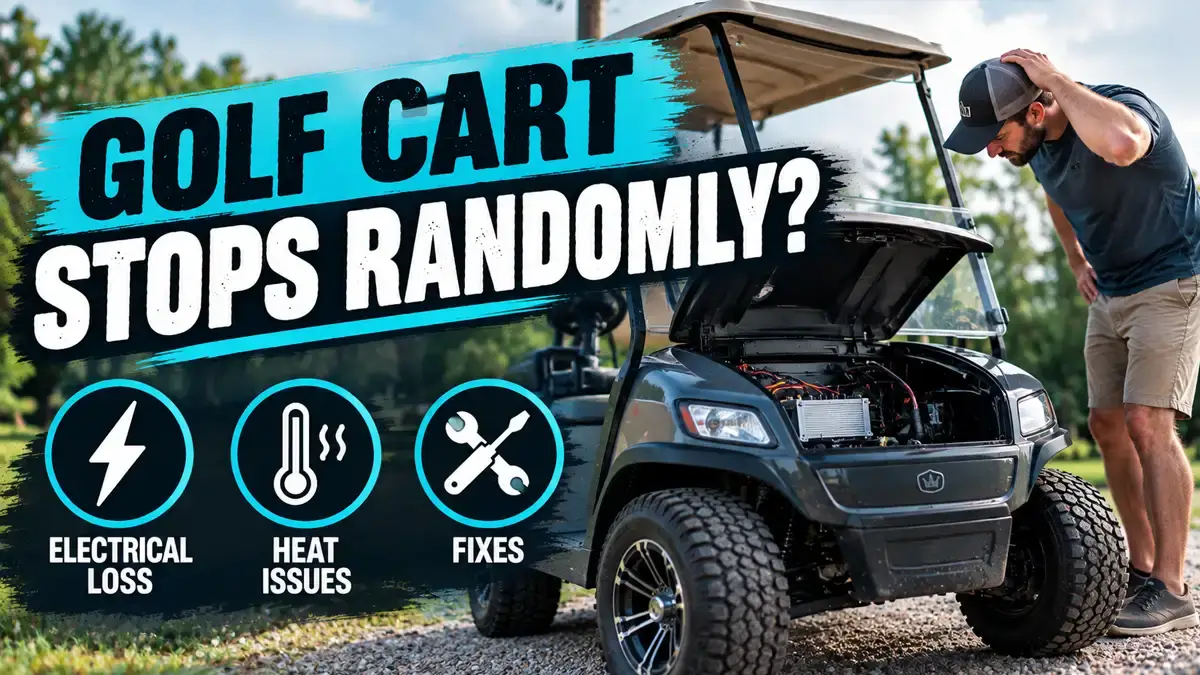
Summary: A golf cart that stops randomly usually has an electrical loss or a heat problem. Loose or corroded battery cables, weak batteries, a failing solenoid, a worn key switch, or a tripped lithium battery protection circuit can all cut power. The controller can also enter protection mode from low voltage, high current, or heat. The fastest way to find the cause is to notice what happens when the cart stops. This guide shows you how to read those clues, what to test, and when to call a pro.
You are rolling along. Then the cart goes quiet. You turn the key and it runs again, or maybe it needs a rest first.
Random shutdowns feel scary. They can also be tricky to track down, because the problem comes and goes. However, there is a smart way to approach it. Start with the clues.
Intermittent problems leave clues. What the cart does when it stops points to where the fault is hiding.
First, Notice What Happens When It Stops
Before you open anything, pay attention. Next time it stops, check these things.
| What you notice | Where to look first |
|---|---|
| Everything goes dead, including lights or display | Battery cables, main fuse, or key switch |
| Lights stay on, but the cart will not go | Solenoid, throttle sensor, or controller |
| It restarts right away after you cycle the key | Controller protection mode or battery protection |
| It restarts only after waiting a while | Heat in the controller or motor |
| It stops over bumps | A loose connection or damaged wire |
| It stops on hills or under load | Weak batteries or voltage sag |
| It stops after rain or washing | Moisture in connections |
Write down the date, the weather, and what you were doing. A simple log can save hours of guessing.
If your cart clicks but will not move, our guide to golf cart accelerator problems covers that symptom in detail. If it will not start at all, read troubleshooting a golf cart that won’t start.
Electrical Loss: The Most Common Cause
Electric carts need steady, strong power. Even a brief break in that flow can shut the cart down. That is why electrical loss is the first place to look.
Loose or corroded battery connections
This is the number one cause of random stops. A loose terminal can lose contact over a bump. Corrosion adds resistance and cuts power under load.
Look for:
- White or green buildup on terminals.
- Cables that wiggle by hand.
- Melted or discolored insulation.
- Cracked cable ends.
Weak or failing batteries
A tired battery can hold enough charge to start and still fail under load. The voltage sags, and the controller shuts the cart down to protect itself. On a lead-acid pack, a single bad battery can drag down the whole set. Learn more in our guide to types of golf cart batteries.
One weak battery can cause the whole pack to quit. Test them individually, not just as a set.
Lithium battery protection
Lithium carts use a battery management system (BMS). It shuts the battery off when it sees low voltage, high current, or extreme temperature. The cart may stop with no warning. Reset steps vary by brand, so check your manual.
Other electrical suspects
- A failing solenoid. It may click, or it may fail to close at random.
- A worn key switch. The cart cuts out when the switch wiggles.
- A blown or loose fuse. Check the main fuse and any inline fuses.
- The forward and reverse switch. Dirty or worn contacts can drop power.
- A damaged wiring harness. Vibration can rub wires until they short or break.
- Moisture. Water in connectors causes on-and-off faults. See our tips to weatherproof your golf cart.
Charging trouble can also hide behind random stops. If your cart is not holding a charge, read why a golf cart won’t charge.
Controller Protection Mode: The Pro Move
Here is something many owners miss. The controller does not just pass power along. It also watches for trouble.
Pro Move: Forum Insight. Owners on golf cart forums often trace random shutdowns back to the controller’s protection mode.
Protection mode can start from several triggers:
- Low battery voltage under load.
- Too much current draw.
- A throttle or sensor fault.
- Too much heat.
When that happens, the controller cuts power on purpose. It is protecting itself, the motor, and the batteries. Many controllers show a status light or a fault code. That code is a big clue, so look for it before you reset anything.
Protection mode is a symptom, not the root problem. If you keep resetting it, the cause will come back.
Heat Issues: When the Cart Stops Only on Hot Days
Heat can shut down a cart too. A hot controller or motor will cut back power or stop entirely. You will often see it on hot afternoons, long climbs, or heavy loads. In the Central Valley, summer heat makes this more common.
The cart usually restarts after it cools. That is a strong sign of a heat problem. For causes and fixes, read our full guide to golf cart overheating.
How to Fix a Golf Cart That Stops Randomly
Work from simple to complex.
Safety first
- Park on level ground and set the brake.
- Turn the key off and put the cart in tow or maintenance mode.
- Disconnect the main battery before you touch wiring.
- Wear eye protection and gloves around lead-acid batteries.
- Follow the maker’s steps for lithium carts.
Step-by-step
- Check the battery connections. Clean any corrosion. Tighten each terminal to spec.
- Inspect cables. Replace any that are cracked, melted, or loose at the lug.
- Check fuses. Make sure the main fuse and inline fuses are good and seated tight.
- Test the batteries. Check voltage at rest and under load. A big drop under load points to weak batteries.
- Check water levels on lead-acid batteries. Top off with distilled water only.
- Do a gentle wiggle test. With power off, move wires and plugs at the controller, solenoid, and key switch. Look for loose spots.
- Look for fault codes. Note any flashing light or code from the controller or BMS.
- Clear the airflow. Remove dust and clutter around the controller and motor.
- Review recent changes. A new accessory, a lift, or a speed upgrade can overload the system.
- Get a pro test. If it keeps happening, have a technician load test the batteries and scan the controller.
Do not keep restarting a cart that shuts off again and again. Repeated resets can hide a fault and stress the parts.
A Safety Note for Street Legal Carts
A sudden stop on a public road is risky. If your cart is street legal, fix intermittent shutdowns before you drive on busy roads. Brakes, lights, and mirrors all matter. See our guide to golf cart safety equipment.
How to Prevent Random Shutdowns
- Check battery terminals every month.
- Keep connections clean and dry.
- Avoid pressure washing the electrical area.
- Replace old batteries before they fail.
- Keep the under-seat area clear.
- Follow a regular service plan with our golf cart service and maintenance team.
When to Call a Pro
Book a service visit if you notice any of these:
- The problem keeps coming back after you clean and tighten connections.
- You see melted wires or smell burning.
- A battery looks swollen or leaks.
- The controller shows repeated fault codes.
- The cart shuts down on hills or in traffic.
Our service team in Visalia can find the cause fast. We also work on popular brands. Owners of these carts may find our guides on Evolution golf cart problems and troubleshooting a Denago Rover helpful.
Time for a More Reliable Cart?
If repairs keep piling up, a newer cart may cost less over time. Browse new golf carts or save with used golf carts. Compare popular Evolution golf carts or see our street legal golf carts. Want to spread out the cost? Read our financing and rent-to-own guide.
Frequently Asked Questions
Why does my golf cart stop randomly while driving?
Random stops usually come from an electrical loss or a heat problem. Loose or corroded battery cables, weak batteries, a failing solenoid, a worn key switch, a tripped lithium battery protection circuit, or a controller in protection mode are the most common causes.
Why does my golf cart shut off and then start again?
That pattern points to an intermittent fault. If it restarts right after you cycle the key, suspect a loose connection, controller protection mode, or battery protection. If it only restarts after waiting, heat is the more likely cause.
Can bad batteries make a golf cart cut out?
Yes. A weak battery can seem fine at rest and then sag under load. The controller then cuts power to protect the system. On lead-acid packs, one bad battery can affect the whole set, so test each battery.
What is controller protection mode on a golf cart?
Protection mode is a safety response. The controller cuts or reduces power when it detects low voltage, too much current, a sensor fault, or high heat. Many controllers show a status light or fault code that helps you find the cause.
Can a loose battery cable cause my golf cart to stop?
Yes, and it is one of the most common causes. A loose or corroded terminal can break contact over a bump or add resistance under load. Clean and tighten all battery connections as a first step.
Is it safe to drive a golf cart that keeps shutting off?
It is not a good idea. A sudden stop can be dangerous on hills, in traffic, or on public roads. Find and fix the cause before you keep driving, and stop using the cart if you smell burning or see melted wiring.
Need Help Tracking Down a Random Shutdown?
Visit Central Valley Carts or book a visit with our service team. We will test the batteries, wiring, and controller and fix the real cause.