
The Short Answer
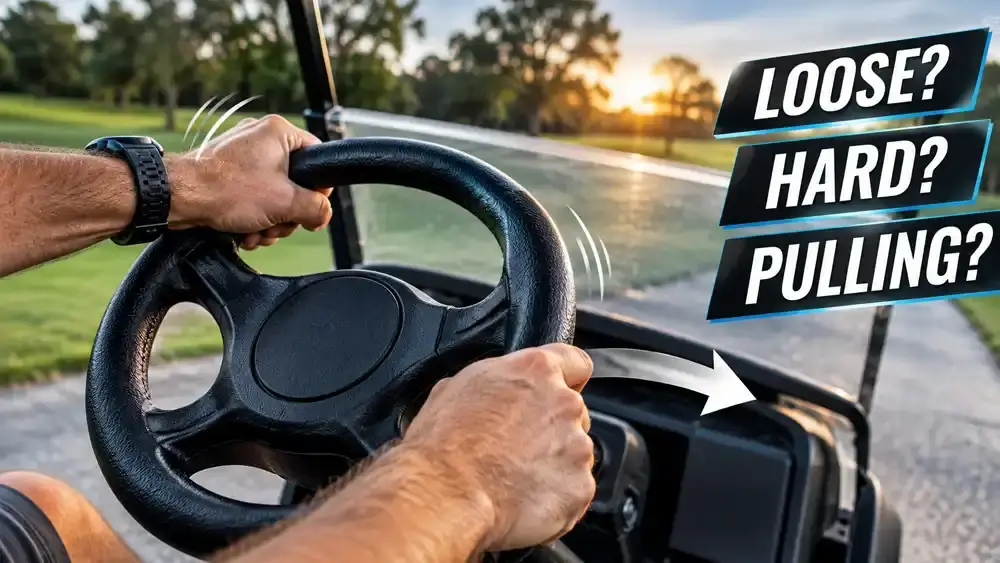
Steering that feels loose, stiff, or crooked is rarely a mystery. In most carts, one of four things is to blame. These are tire pressure, worn tie rod ends, worn king pins or wheel bearings, and toe alignment.
The good news is that you can test all four in your driveway. You need a jack, jack stands, and about an hour. This guide shows you how, step by step. It also shows when to stop and call a pro.
Alignment cannot fix a worn part. Always check for play before you adjust anything.
New to troubleshooting? Start with our golf cart troubleshooting hub. It covers the most common problems across the whole cart.
How Golf Cart Steering Works
Knowing the layout helps you find the problem faster. Most carts use one of two designs.
- Rack and pinion. Common on Club Car DS and Precedent, Yamaha G29 and Drive, and many newer carts. The steering wheel turns a pinion gear. The pinion slides a rack left and right. Tie rods then turn the wheels.
- Steering box with linkage. Common on older E-Z-GO TXT and Marathon carts. A steering box moves a linkage and tie rods. Much of the “slop” on these carts comes from worn tie rod ends and king pin bushings, not the box.
Either way, the force travels the same path: steering wheel, column and joints, rack or box, tie rods, tie rod ends, and finally the steering knuckles and king pins at each wheel. A worn part anywhere along that path causes slop.
Safety First and Tools You Need
- Park on level ground and chock the rear wheels.
- Turn the key off and set the cart to tow or maintenance mode.
- Disconnect the main battery before you work near wiring. Follow the maker’s steps on lithium carts.
- Lift the front with a jack, then support it on jack stands. Never work under a cart held only by a jack.
- Floor jack and two jack stands
- Socket and wrench set
- Tire pressure gauge
- Tape measure
- Grease gun and cart-safe grease
- Pry bar and flashlight
Steering Symptoms and What They Usually Mean
| Symptom | Most likely causes | DIY level |
|---|---|---|
| Loose steering, lots of play | Worn tie rod ends, loose steering hardware, worn king pins, rack or box wear | Easy to moderate |
| Hard to turn | Low tire pressure, dry king pins, binding column, bent parts, oversized tires | Easy to moderate |
| Pulls to one side | Uneven tire pressure, dragging brake, toe error, worn tie rod end, bent spindle | Easy to moderate |
| Wanders or feels darty | Worn tie rod ends, toe-out, loose rack, worn bushings | Moderate |
| Clunk over bumps | Tie rod ends, rack mounts, shock or spring bushings | Moderate |
| Squeal or groan when turning | Dry king pins or bushings, dry rack | Easy |
| Steering wheel off-center | Tie rod length changed, toe set unevenly | Moderate |
| Violent shake at speed | Several worn parts plus toe error, often on lifted carts | Pro |
Steering Symptom Finder
Pick the symptom that matches your cart. We will show likely causes, the first test to run, and your next step.
Step 1: Check Tire Pressure and Look Over the Front End
Start with the cheapest fix. Low or uneven tire pressure makes steering heavy and makes the cart pull. Check all four tires with a gauge. Set pressure to the number on the tire sidewall or in your manual. Then walk around the front end and look for:
- Bent or cracked steering parts.
- Torn rubber boots on the rack.
- Loose nuts and missing cotter pins.
- Grease or oil on the steering parts.
- Uneven tire wear, such as one worn edge.
Flat or leaking tire? See how to fix a flat tire on a golf cart or book tire service.
Step 2: The 12-and-6 Test (Wheel Bearings and King Pins)
- Lift the front end and set it on jack stands.
- Grip one tire at the top (12 o’clock) and the bottom (6 o’clock).
- Rock it in and out. Push at the top while you pull at the bottom, then reverse.
- Watch the hub, spindle, and king pin area while a helper rocks the tire.
What you are feeling for: Any clunk or visible movement points to a worn wheel bearing, a loose spindle nut, or worn king pin bushings. Compare the left and right sides. A healthy wheel feels tight.
Step 3: The 3-and-9 Test (Tie Rod Ends)
- With the front still supported, grip the tire at 3 o’clock and 9 o’clock.
- Push one hand forward while you pull the other back. Rock it side to side.
- Have a helper watch each tie rod end and joint.
What you are feeling for: Movement at the tire with no movement at the steering wheel points to a worn tie rod end. If the rod moves but the tire does not, the end is loose or worn out. Replace any end with play.
If the wheel moves and the steering wheel does not, the slop is in a tie rod end or joint.
Step 4: Check Steering Wheel Free Play, the Column, and the Rack
Now look at the inside of the system. With the front on the ground, turn the steering wheel gently back and forth. Watch the front wheels.
- Wheel moves, tires wait: Play is in the column joints, the pinion, or the rack or box. Check the steering shaft U-joints and the rack mounting bolts first.
- Rack moves, one tire waits: The problem is an inner tie rod or an outer tie rod end.
- Tight spots or binding: Suspect a dry or bent column bushing, a dry rack, or damaged parts.
Some racks have an adjuster that removes small amounts of gear lash. It is not a cure for worn tie rod ends or king pins. Adjust the rack only after you fix other play, and follow your model’s procedure.
Step 5: Check and Set Toe-In (Alignment)
Toe describes how the front tires point in or out when viewed from above. Most carts run a small amount of toe-in. Many guides cite about 1/8 to 1/4 inch, but check your manual for your exact spec.
- Fix any play first. Alignment will not hold on worn parts.
- Set tire pressure equally.
- Roll the cart forward 7 to 10 feet on level ground so the parts settle. Keep the wheels straight.
- Measure the distance between the tire centers at the front and at the rear, at hub height. Front should be slightly smaller than rear for toe-in.
- Loosen the jam nuts on both tie rods.
- Turn each tie rod barrel the same amount. Shortening the rods increases toe-in. Lengthening reduces it.
- Tighten the jam nuts to your manual’s torque. Roll the cart again and re-measure.
- If the steering wheel is crooked, adjust both sides equally. Do not move just one side.
Tip: After replacing tie rod ends, you must re-check alignment. Counting threads is not accurate enough.
Fixes by Problem
Loose or wandering steering
Replace worn tie rod ends first. Then replace worn king pin bushings or bearings. Tighten loose hardware to spec. Re-check toe afterward.
Hard steering
Fix tire pressure. Grease any fittings your cart has. Check for a binding column or bent steering part. If you added tall tires, remember they increase steering effort and put more leverage on every steering part.
Pulling to one side
Check tire pressure and a dragging brake. Spin each front wheel by hand. If one drags, see our guide on brake problems and worn pads. If the pull continues, a bent spindle or worn bearing is likely.
Squeals and groans
Dry king pins and bushings often cause this. Grease where your cart has fittings. If the noise stays, the bushings may be worn.
Violent shake at speed
This is often a combination of worn king pin bushings, worn arm bushings, and toe error. It is common on lifted carts. A steering stabilizer can calm the feel, but never use one to hide worn parts. Stop driving at speed until it is fixed.
Lifts, Big Tires, and Steering
Modifications change how your cart steers. Larger tires add leverage to every steering part. Lift blocks or kits can change the king pin angle, which affects caster and how the cart tracks. If your cart started to wander after a lift, check the lift install first.
- Read about lift kits and installation.
- See the pros and cons of mud tires.
- Browse extreme golf cart modifications.
- Learn about golf cart stabilizers.
- Check wheel and tire fit in our golf cart wheels guide.
Carts With Power Steering
Some newer carts use electric power steering. If the steering suddenly gets heavy, the system may have lost its 12-volt supply. Check the fuse and the voltage reducer first. Our guide on golf cart lights not working shows how to test the 12-volt system. Persistent faults need a technician with the right scan tools.
DIY or Call a Pro?
- Setting tire pressure
- Tightening steering hardware
- Greasing fittings
- Replacing tie rod ends
- Basic toe adjustment
- Rack or steering box damage
- Bent spindles, drag links, or frame parts
- King pin or bushing replacement you cannot finish
- Alignment that will not hold
- Shake at speed on a lifted cart
Steering is a safety system. If you are not sure, stop and ask. Our service department can inspect and repair the front end. Want a full checkup? Ask about our golf cart tune-up services.
Steering and Street Legal Carts
If you drive on public roads, steering and brakes matter even more. Review California golf cart laws and our guide to a street legal golf cart.
How to Prevent Steering Problems
- Check tire pressure monthly.
- Look under the front end each season.
- Avoid hitting curbs and potholes at speed.
- Grease fittings on schedule.
- Re-check alignment after tire, lift, or suspension changes.
- Follow our maintenance tips to extend lifespan.
Hitting bumps hard? Our sister site explains suspension setup for rough terrain.
Frequently Asked Questions
Why is my golf cart steering loose?
Loose steering usually comes from worn tie rod ends, loose steering hardware, worn king pins or bushings, or wear in the rack or steering box. Use the 3-and-9 and 12-and-6 rock tests to find which part is moving.
Why is my golf cart hard to steer?
Low or uneven tire pressure is the most common cause. Dry king pins, a binding steering column, bent parts, and oversized tires can also make steering heavy. Check tire pressure first, then lift the front and turn the wheel by hand.
Why does my golf cart pull to one side?
Common causes include uneven tire pressure, a dragging brake, incorrect toe alignment, a worn tie rod end, or a bent spindle. Check tire pressure and spin each front wheel by hand before adjusting alignment.
How do I test for worn tie rod ends on a golf cart?
Lift the front end onto jack stands and grip the tire at 3 and 9 o'clock. Rock it side to side while a helper watches each tie rod end. Any movement at the joint means the end is worn and should be replaced.
What should toe-in be on a golf cart?
Many guides cite about 1/8 to 1/4 inch of toe-in, but the correct spec depends on your make and model. Check your service manual, roll the cart a few feet before measuring, and adjust both tie rods equally.
Can a lift kit cause steering problems?
Yes. Lift blocks and kits can change king pin angle and caster, and larger tires add leverage on steering parts. If your cart wanders or shakes after a lift, have the install and alignment checked.
Is it safe to drive a golf cart with loose steering?
It is not a good idea. Loose steering reduces control and can get worse quickly, especially at speed or on hills. Find and fix the worn part before regular driving, and stop if the cart shakes or wanders.
